Pages

Showing posts with label Energy. Show all posts

Sunday, December 15, 2013

Destroying Planets & Stuff

We've all grown up on Star Wars. One of the most vivid scenes of the movie that we all never forget is when the Death Star destroyed Alderaan. It immediately made a deep impression on our psyches. It bespoke the power of the Galactic Empire and cowed even us- the audience looking upon an illusion, to think twice before opposing the Emperor.

The spectacle also probably broke the movie's illusion somewhat- because we all asked ourselves whether such a thing as this were possible in the real world? Is it scientifically possible to destroy a planet like the Death Star destroyed Alderaan?

In a word: yes.

And the method is actually fairly simple as well. For something to be capable of destroying a planet (or star, or other astronomical object that is a sphere with a roughly average density), it needs to generate enough energy (in joules) to overcome that object's gravitational binding energy. That is, the energy by which a planet's gravity binds its mass together as a single object. Equal or exceed that, and the planet's mass is scattered far enough so that its gravity will not pull it back together again. This means that the debris will equal or exceed a planet's escape velocity (more on escape velocity in another post).

The equation for figuring out gravitational binding energy is as follows:


The gravitational binding energy of a spherical astronomical object (like a planet or star) is U. G is the gravitational constant (6.67x10^-11), M is the mass of the object, and r is its radius in meters (keep that in mind, because if you put its radius in kilometers, as you may find preferable when dealing with objects this big, you will get nonsensical results).

Now let's use the Earth as an example of putting this equation in action.

The Earth's mass, as you may know, is 5.97219×10^24 kilograms. Its radius in meters is 6,378,100.

Now with my favored calculator, this is very easily solved:

5.97219×10^24 = 5972190000000000000000000
6.67x10^-11 = 0.0000000000667

3 x 0.0000000000667 x 5972190000000000000000000^2 / (6378100 x 5) = 223796346390292093256612470798513.66394380771703171790972.

There is your gravitational binding energy in joules. Obviously this is a large and very abstract number that is difficult for most people to make sense of. For this reason, I generally prefer to break the joules down into TNT equivalent, which is far easier to grasp.

Using a simple energy converter, you will find that the answer in terms of TNT equivalent is 5.3488610514e+22 tons of TNT. That's 53.488 sextillion tons, which you can verbalize using this numbers to words converter. In metric prefixes, the number sextillion is denoted by the word "zetta." So the gravitational binding energy of Earth is 53.488 zettatons of TNT.

This is obviously, again, a staggering amount of energy (though not as much as the kinetic energy of the planet's orbit). For some perspective, the Tsar Bomba, the most destructive weapon ever constructed by man, at around 50-60 megatons (the word "mega" denotes the number million in metrix prefixes), was a quadrillion times less powerful.

This equation isn't perfect, of course. It assumes both uniform density (which astronomical objects do not possess), and a perfect sphere (which again, the Earth and other bodies are not), but this is a good estimate of the Earth's gravitational binding energy and is more than usable in a scientific context.

And if you're lazy and don't want to use the equation, you can try the SD.net Planetary Parameter Calculator, and look for the "Death Star yield LL." It will be second from bottom on the right. By inputting the parameters of your object to the left, the calculator will tell you the gravitational binding energy of your object, though the surface gravity requirement might be a hassle if you're looking for an answer for an exotic star, for instance.

So, summing up...

1. To destroy a planet, star, or other large spherical object in space, you must overcome its gravitational binding energy.
2. To solve for this you can do the equation given above.
3. This equation is only a (good) approximation most of the time however, because it assumes perfect spheres and uniform density, which most astronomical objects do not have.

As a final note, you can use the kinetic energy equation to get a more accurate measurement of the power of a planet destroyer like the Death Star. By taking the velocity of a planet's mass scattering beyond its original radius, you can find the energy behind the attack. This will often be far higher in entertainment media than the bare minimum gravitational binding energy. Such was the case with the Death Star. Planet Busters Death Star Destroyers Star Wars Binding Energy Astronomy

Friday, November 15, 2013

The Most Famous Equation


Why is the sun so powerful? Why do nuclear weapons create such a big boom? The answer can be broken down to mass-energy equivalence, as expressed by the most famous equation in all of science.

Contrary to popular belief Einstein was not the first one to ever propose a relationship between mass and energy, but he is the one that created the formula, which is a natural result from his theories of relativity.

An examination of the wonderfully simple equation reveals the answer as to why atomic physics deals with such powerful levels of energy.

"c" stands for the speed of light- 299,792,458 meters per second. The equation then squares this number and multiplies that by the mass of the object. There is your answer in joules. As you can already guess, the number of joules (and thus the amount of energy measured) is staggering. Put simply, it's the most efficient release of energy known to science. Whereas the breaking of chemical bonds releases some energy, it pales in comparison to any nuclear process where a mass-energy dynamic is present. Let's try an example:

Say that one kilogram of matter is converted entirely into energy.

1 x 299,792,458^2 = 89875517873681764 joules.

That is equivalent to 21.480 megatons of TNT- a yield nearing one of the most powerful thermonuclear devices ever tested.

The Castle Yankee device, which converted less than one kilogram

And that's only one kilogram, one!

Mass-energy equivalence is serious stuff, friends.

What makes it all go is the loss of mass in a system. This lost mass then gets converted entirely into energy. When a nuclear weapon goes boom, the spectacularly destructive results that you see is due to a certain loss of mass in the original system. The same forces are at play inside the cores of the stars.


The sun for instance, loses 4 million metric tons per second, converting some of that lost mass into energy. The slightly less massive sun then radiates that energy at about 3.846 x 10^26 watts per second, or around 91.921 petatons of TNT per second (that's 91.921 quadrillion tons), over a trillion times more powerful than the Tsar Bomba. More massive stars do this at even higher rates and produce even more energy.

That's mass-energy equivalence in a nutshell.

Saturday, November 2, 2013

Starting Simple: Kinetic Energy

We might as well start off this blog with a simple post about kinetic energy. Firstly, let's define it: kinetic energy is the energy (the capacity for doing work on something) of an object that is imparted by its motion. The reason why a fist hurts you when you get punched is due to the kinetic energy of the fist. The kinetic energy of a speeding car is the reason why it kills you when you get hit by it. This sounds simple, but is more pervasive and subtle than you may think. Heat (or lack thereof) can also be seen to be a form of kinetic energy. How? The thing that distinguishes something that is hot from something that is cold is the speed at which its constituent matter is moving. This is kinetic energy.

A-Rod hurt by the kinetic energy of the ball

So how is this thing called kinetic energy solved?

In classical, Newtonian mechanics, the kinetic energy of an object in joules (the measurement unit of energy) can be found by multiplying half of its mass times its velocity squared, as illustrated below:

KE = .5mv^2

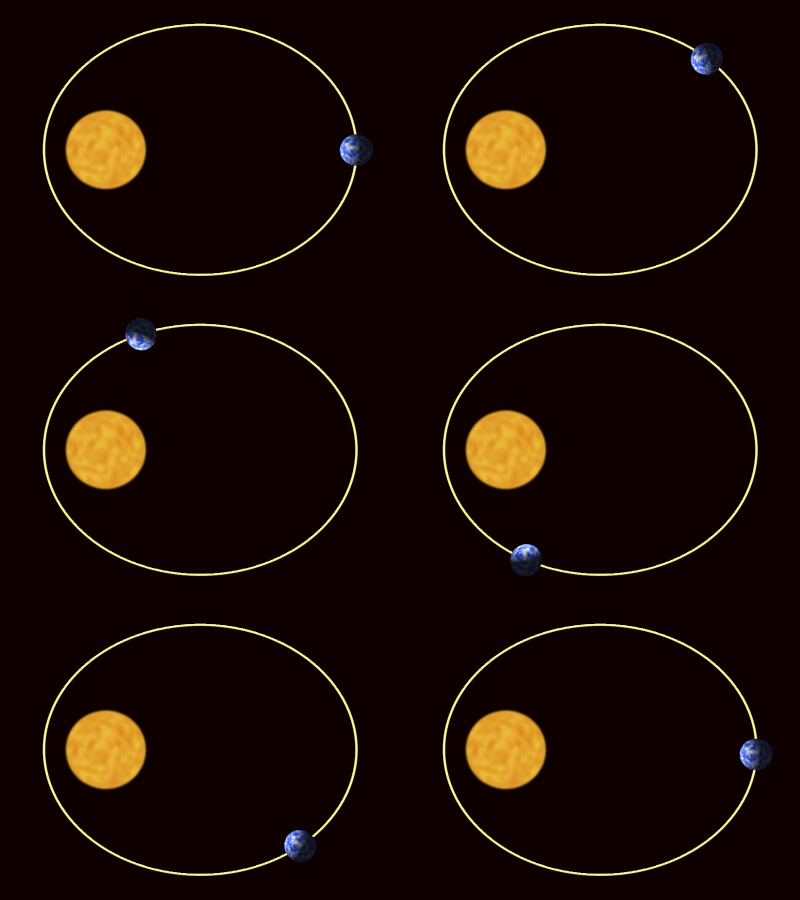
So we can solve for the kinetic energy of an object in this way. Let's do something fun- something really big. How about the kinetic energy of the Earth itself in its orbit around the Sun?

How energetic is this planet?

The first order of business is to find the mass of your object (in this case the Earth) in kilograms. Kilograms is bolded because if you don't measure your object in kilograms, your calculation will be nonsensical. In the age of Wikipedia, this task which may have been a tall order in the past is today pretty easy.

The Earth's mass is listed as being 5.97219×1024 kilograms, via a NASA source. Don't be intimidated by the 10^24 label. Any advanced calculator will be able to give you the answer (and most of your equations in school likely won't have numbers anywhere near as large). If you're feeling very masochistic, you can just write out the number 1 followed by 24 zeros after the number 9.

This calculator (which I'll do a post on later) can give you an easy answer: 5972190000000000000000000 (also do take note that you can just leave it as written above and work with it in that calculator).

Next, you need to find the velocity of your object in meters per second. This is important, especially for those of us living in the United States where our typical measurement of speed or velocity is in miles per hour. If you do not put your velocity in meters per second, your number will again be nonsensical.

Don't do this
A quick check back on Wikipedia reveals that the Earth orbits its parent star at a velocity of 29.78 kilometers per second on average. Simply multiplying this number by 1,000 gets your velocity in meters per second at 29,780.

Now that we have our components (5972190000000000000000000 kilograms, 29,780 meters per second), we can find the kinetic energy of this object in joules:

5972190000000000000000000 x .5 = 2986095000000000000000000

2986095000000000000000000 x 29,780^2 = 2648213572998000000000000000000000.

That is the kinetic energy of the Earth in joules. Needless to say, this is obviously a staggering amount of energy, far more than enough to destroy the planet itself (more on that fun stuff in a future post).

Now I'll let you cheat and use this kinetic energy calculator that I've been keen on using. It lets you solve for mass, kinetic energy, or velocity. It's pretty neat (do however make sure to put the whole mass into its proper component, not half of it also, no commas).

A quick check reveals that the answer it gives you is essentially the same number as doing it the long-hand way.

HOWEVER...

there is a snag. This equation and thus this answer is technically incorrect (or at least, was derived in an incorrect way).

No, this answer being technically incorrect (or incorrectly derived) isn't something even a scientist is typically going to have to worry about, but in other cases, it will show itself.

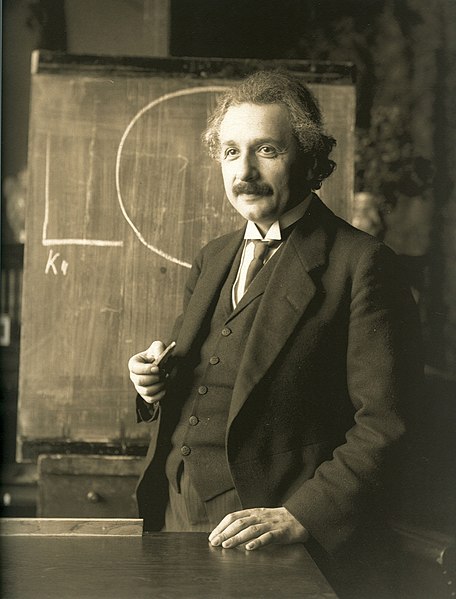
The problem arises due to the revelations of that most famous of all scientists, Albert Einstein. His experiments in the early 20th century proved that the Newtonian view of gravity, mass, and matter was incorrect. By revealing the true nature of space-time, Newton was eclipsed. This upset a lot of people.

Trollin' like a mo fo
The true, proper equation for kinetic energy can be found on this page.

Confused yet? Don't worry, I am too! You probably won't need to worry about this unless you're taking university-level physics (hence, not me), but I'll go into detail regarding why this way is technically correct (because it's at least an interesting caveat and will make you more knowledgeable about the universe).

While Newtonian mechanics works well in explaining the properties (in this case, kinetic energy) of everyday objects moving at normal speeds (yes, this includes things like stars and planets in their orbits, go figure), it cannot explain the properties of very small objects (like subatomic particles) or very big objects (like black holes). It also cannot measure for objects moving at velocities approaching the speed of light where the effects predicted by the Theory of Relativity start to become noticeable to an observer (things like time dilation and mass increase). Generally, this starts to happen at around 10% of the speed of light (29,979,245.8 m/s).

Going back to our example of the Earth in its natural orbiting speed, you can take a look at stardestroyer.net's fantastic relativity calculator (yes, things like this fortunately do exist to simplify Relativistic kinetic energy should you wind up needing to use it). Inputting the variables above, we find that the Newtonian and Relativistic answers in joules for Earth's kinetic energy are identical:

2.648E+33 (2648000000000000000000000000000000) joules, essentially the same answer arrived at multiple times above.

But how about if the Earth was orbiting at 50% of the speed of light (149896229 m/s), and somehow we were all still alive to ponder it?

The Newtonian kinetic energy is: 6.709E+40 joules.

The Relativistic kinetic energy is: 8.301E+40 joules.

A noticeable and important difference is revealed. Though it might seem small (a differential of 1.237 times), it is significant, and it will increase exponentially the closer you get to the speed of light.

So at the end of the day...

What have we learned?

1. Kinetic energy is the energy of an object based around its motion.
2. You can solve for an object's kinetic energy by taking half of its mass, and multiplying it by the square of its velocity (.5mv^2).
3. This equation however is only a very good approximation in most cases, and cannot explain for objects of very small or very large mass, or for objects traveling at a velocity nearing the speed of light (starting at around 10%).
4. Breathe a sigh of relief that for 99% of you, relativistic kinetic energy won't be anything you need to worry about.
5. Einstein trolled the entire scientific establishment with his findings.

Kinetic Energy Albert Einstein Isaac Newton Classical Relativistic Mechanics